Shared context for people and agents.

CreatorNotes keeps your notes, decisions, and evolving ideas connected and current, so every session builds on the same understanding.

Your terminalCopy
npx @creator-notes/cnotes@latest init

Node 18+. Works in any terminal, including Codespaces and remote SSH.

Works with

Claude Code
Codex
Cursor

and any agent with CLI or MCP access

Explore a live workspace

See it work

Watch an agent build a canvas.

Starting from scratch, it sets up CreatorNotes and connects the notes, evidence, and decisions as it works.

The problem

Your team moves fast. Your context doesn’t.

AI helps your team produce more work in less time.

But the thinking behind that work rarely stays connected. Decisions get separated from evidence. Assumptions lose their source. The project keeps moving, but its memory falls behind.

The important thinking ends up split across

  • Notes
  • Chats
  • Docs
  • Meetings
  • AI conversations
  • Screenshots
  • Half-finished ideas
  • Threads nobody can trace

So every handoff starts with reconstruction instead of progress. People and agents have to rediscover what happened, reopen old questions, and rebuild context before they can do useful work.

Why did we decide this?

What evidence supports it?

What are we still assuming?

What changed since last time?

Can an agent pick up where you left off?

Most of the time you cannot answer without digging. CreatorNotes gives that thinking a place to live.

What it is

You already know artifacts.

Open any AI tool and your work lives in a list on the left: every conversation, stacked in the order it happened, and almost impossible to search. Artifacts were the first move to keep the part worth keeping. CreatorNotes is the version that lasts.

Shareable
Open it up with permissions, so the right people and agents can see it.
Versioned
Every change is kept, along with the reason it changed.
Provenance
You can see who or what touched it: you, a teammate, or an agent.
Atomic
Each note stands on its own, so it can be reused across projects instead of retyped.
Searchable
Find any note by meaning, not just keywords. The timeline and the notes on why each thing changed give search more to grab onto, so the right one surfaces.

The same list you couldn't search now shows what you did and why. Curated memory you and your agents can trust.

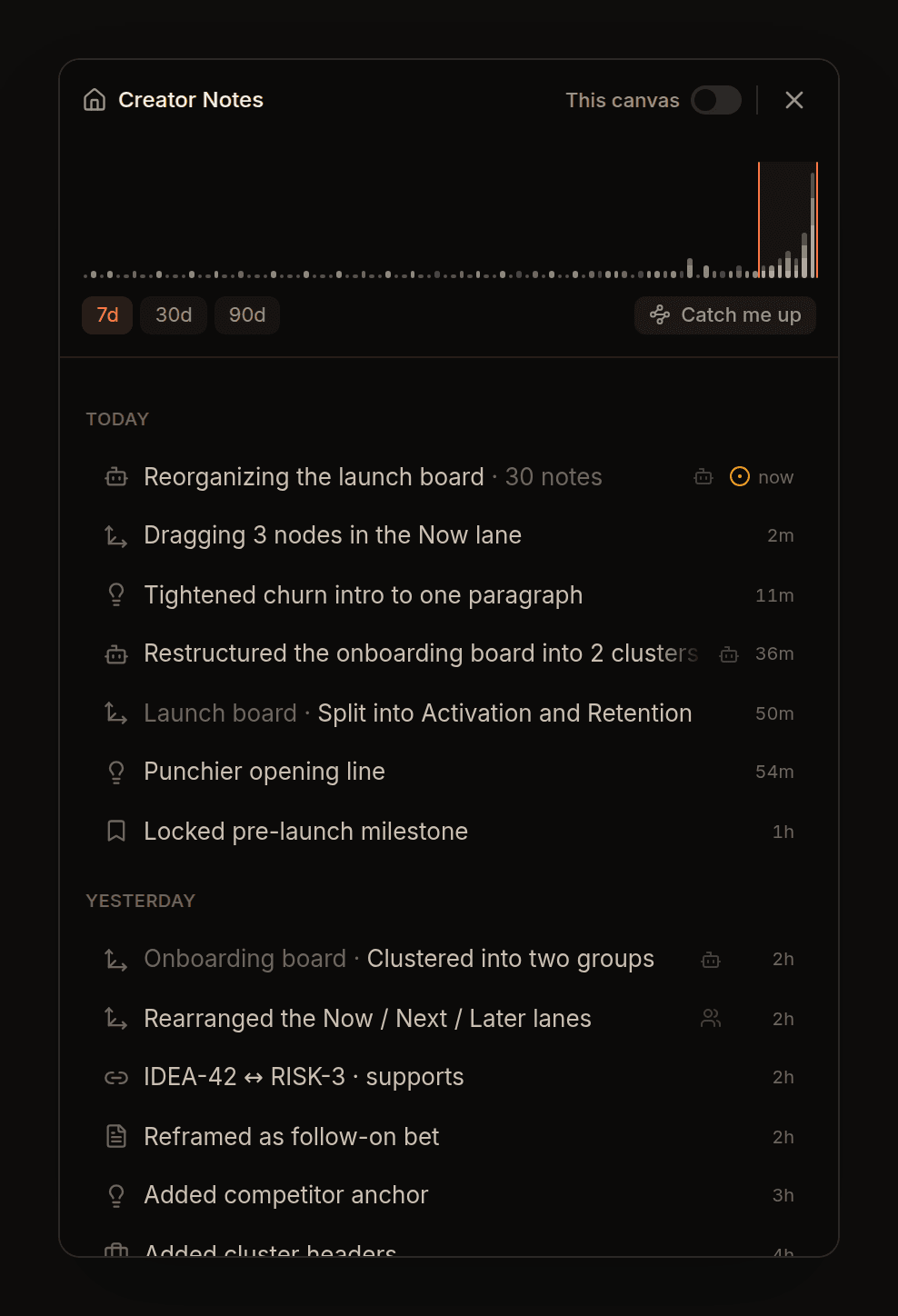
The Timeline panel: an activity chart over a list of recent changes, each row showing what changed, who changed it, and when.
Everything that happenedYou, your teammates, and your agents in one stream. Every row carries what changed and who changed it.
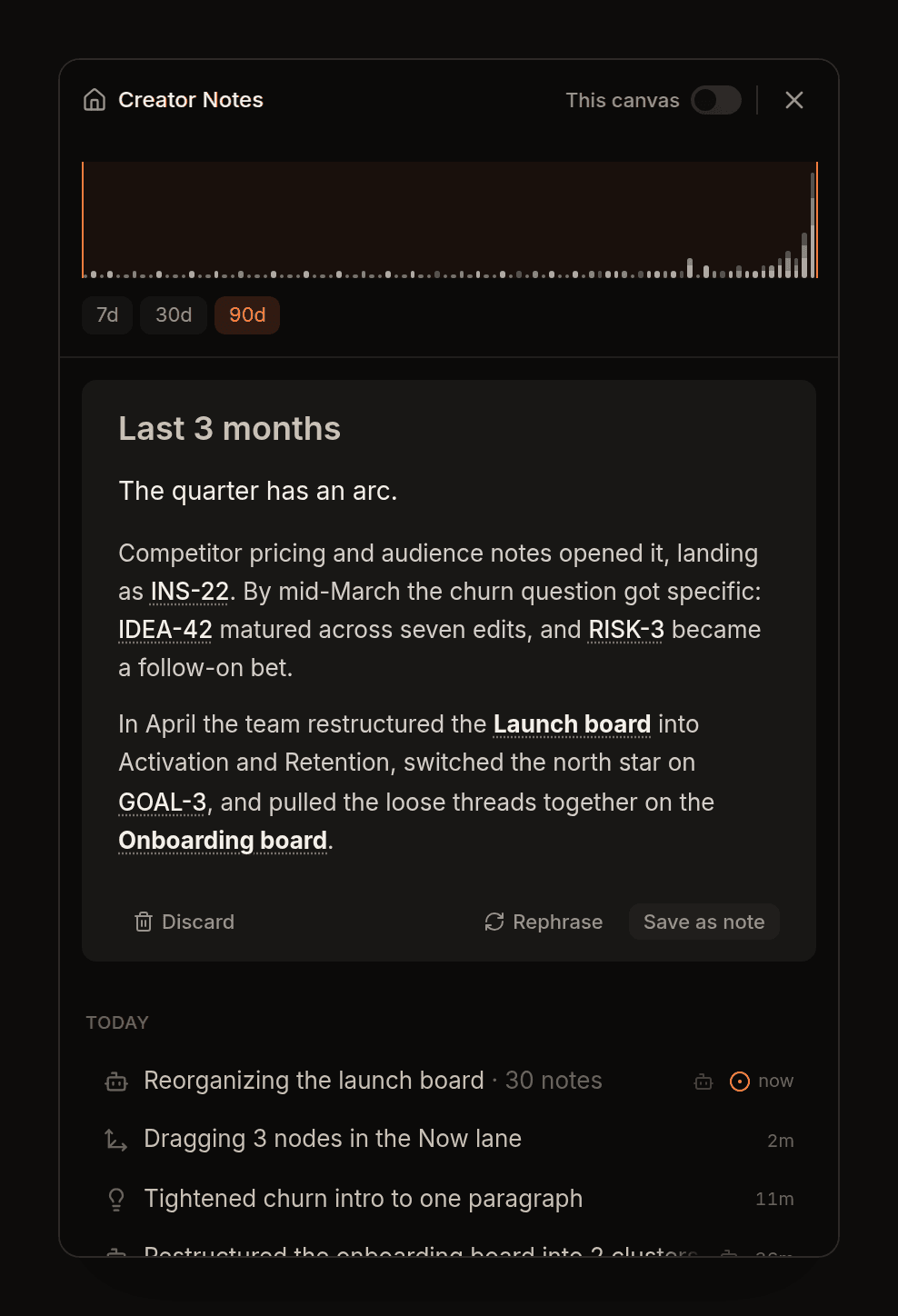
The Timeline panel with a generated "Last 3 months" summary that reads as a structured brief, its mentioned notes and canvases rendered as clickable links, with Discard, Rephrase, and Save as note actions.
Catch me upPick any window and get a written brief that links straight to the notes and canvases it cites.
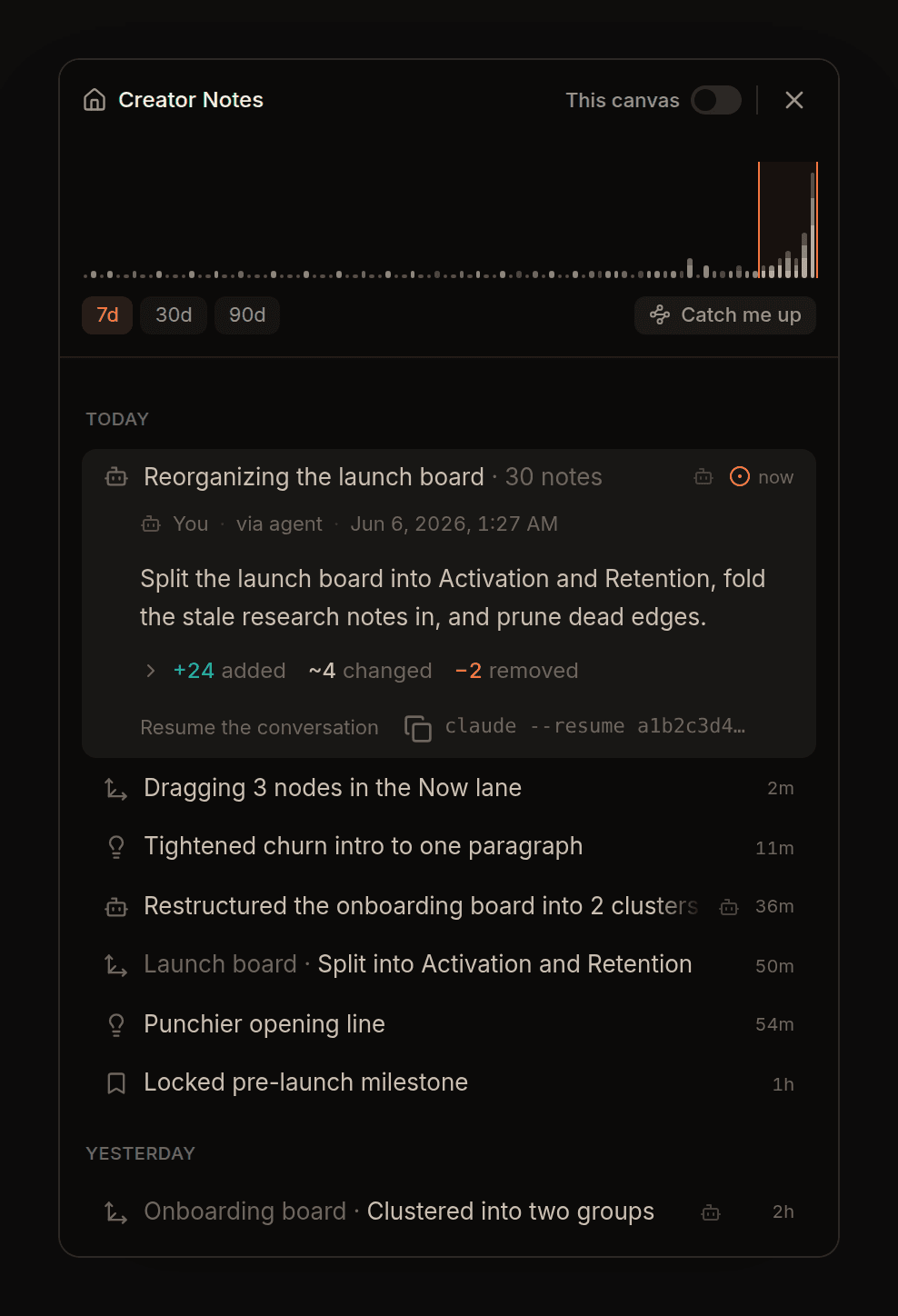
The Timeline panel with an in-progress agent run expanded, showing its intent and a tally of plus 24 added and 4 changed.
Watch an agent workAn agent's whole batch is one row. Open it to see what it touched, added, and changed.

Shared context

One workspace bothpeople and agents can use.

Both sides start from the same context: the evidence, the assumptions, and the decisions behind the work.

People get

A visual, navigable canvas.

See how evidence, assumptions, and decisions connect, and how the thinking changed over time.

Agents get

Structured context they can query and act on.

Agents read the evidence, inspect the assumptions, and understand past decisions before they do anything.

Both work from the same memory.

No copying context into every chat.

No explaining the same project again.

No losing the reasoning behind the work.

Across every team, all at once

Know what changed before you jump back in.

Pick any window and CreatorNotes turns the timeline into a clear brief, with links to the notes, decisions, and evidence behind it.

The CreatorNotes Timeline: a stream of recent changes, each row showing what changed, who or which agent changed it, and when.
What changed while you were heads-down. Who, when, and why.
The Timeline with a generated Catch me up brief that links to the notes and canvases it cites.
Catch me up writes the brief, linked to the notes it cites.

No digging through chats.

No asking what happened.

No redoing work someone already did.

How it works

From capture to clarity.

  1. 01

    Capture

    Start with whatever you have.

    A note, a voice memo, a link, a meeting insight, or a rough idea. No structure required, and you can send it straight from your phone over WhatsApp.

    See WhatsApp capture
  2. 02

    Find the shape

    The system surfaces what matters.

    It helps identify the evidence, claims, assumptions, and possible decisions hiding inside the mess.

  3. 03

    Connect

    Thinking becomes a living map.

    Notes link to their sources, claims, assumptions, and versions. The canvas shows how the work is evolving.

  4. 04

    Continue

    Anyone can pick it up.

    People see the current state. Agents use the same context to summarize, challenge, update, or act.

Built for themessy middle.

The stretch after the first idea and before the decision is final, while the evidence is still forming and the thinking keeps changing. That is where the work that matters happens.

A CreatorNotes note editor: an Insight note titled 'Connections Reveal Hidden Patterns', with its type chip, version, and the number of canvases it lives on.
Every note keeps its type, its version history, and the canvases it lives on.

CreatorNotes keeps all of it in one place, still there when you or an agent come back.

Is this just another AI chatbot?

No. CreatorNotes keeps the context a chat usually leaves behind. The evidence, assumptions, and decisions stay in the workspace, ready for you or an agent to pick up later. The intelligence lives in your graph, not in a chat box.

Can my agents use it?

Yes, that is the point. You run your own agent, like Claude Code, Codex, or Cursor, and it reads and writes the same workspace from the CLI: notes, relationships, decisions, and version history. It acts on current context instead of a one-off prompt.

Do I need to use the terminal?

The CLI is how your agents read and write the workspace, and the fastest way in if you live in a terminal. You do not have to use it yourself, though. Everything you can do from the CLI, you can do in the browser, on the same workspace and the same data.

Do I have to classify every note?

No. You write naturally. CreatorNotes helps surface the claims, assumptions, and decisions when they matter, and stays out of the way when they do not. You should not have to become a librarian of your own mind.

Give people and agentsthe same memory.

One shared place to think, remember, challenge, and decide.

Your terminalCopy
npx @creator-notes/cnotes@latest init

Works with

Claude Code
Codex
Cursor

and any agent with CLI or MCP access

Explore a live workspace